Virtual Museums
How Talking Avatars Are Changing the Way the World Learns Science.
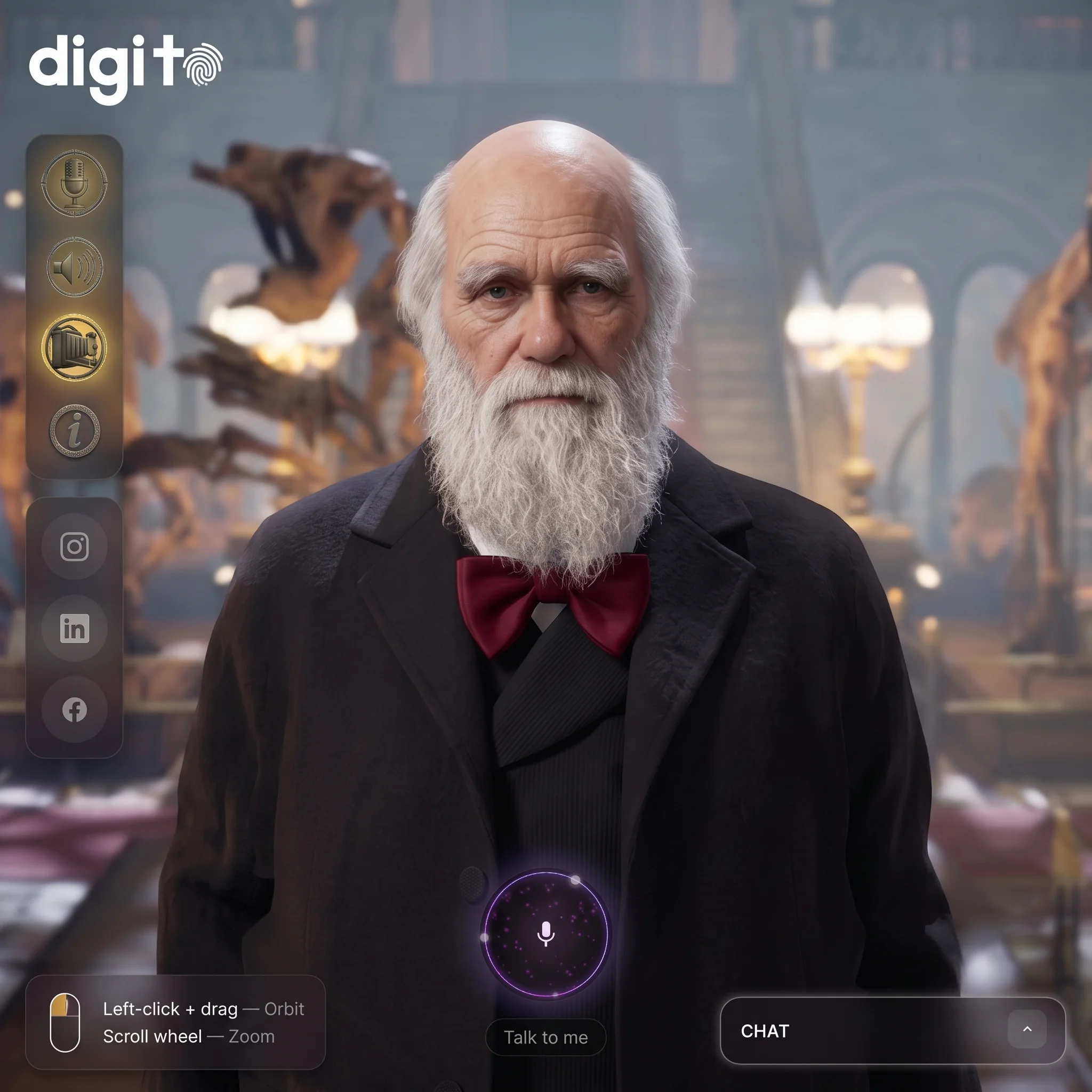
What if children could ask Darwin directly why finches have different beaks? The Darwin Virtual Museum makes that possible, and it points to a future where the world's greatest scientific minds are available to every visitor, in every museum, in every language.
Every major natural history museum in the world has the same problem. They hold extraordinary collections, specimens, fossils, field journals, correspondence, that represent centuries of human curiosity at its most rigorous. And most visitors walk past them in under two minutes.
Not because the visitors are uninterested. Because the format is working against them. Glass cases and printed labels are not conversation. And conversation is how human beings actually learn.
The Darwin Virtual Museum, built by Digito, is a direct answer to that problem. It is the world's first AI-powered virtual museum experience featuring Charles Darwin as a living, conversational digital human, and it is available right now, in any browser, with no installation required.
A Conversation That Textbooks Cannot Have
Picture a ten-year-old standing in front of a taxidermied finch at the Natural History Museum. They read the label. They move on. Thirty seconds. The label told them the bird's name. It told them nothing about why it matters, what Darwin felt when he held it, or how it cracked open one of the most consequential ideas in the history of human thought.
Now picture that same child asking Darwin directly: "Why do the finches all look different?"
Darwin answers. He describes the voyage of the HMS Beagle. He explains what he saw on each island, why the beak shapes confused him at first, and what took years to click into place. He is patient. He adjusts his explanation when the child does not follow. He answers the follow-up question, and the one after that.
That is not a hypothetical. That is exactly what the Darwin Virtual Museum does, and the difference in learning outcomes between those two experiences is not small.
Children learn by asking questions. The problem with every traditional museum format, labels, audio guides, even the best multimedia installations, is that they cannot be questioned. They deliver information in one direction and stop. A conversational avatar has no such limitation. The child leads. The character follows. The learning is genuine, because the curiosity is genuine. Get in touch to bring this experience to your institution.
Why Darwin. Why Now.
Charles Darwin is one of the most studied, most referenced, and most misunderstood figures in the history of science. His ideas underpin modern biology, genetics, ecology, and evolutionary medicine. They are taught in every school in the world. And in almost every case, they are taught through texts that Darwin did not write for students.
The On the Origin of Species is not a textbook. Darwin wrote for a general audience, but the journey that produced it, the observations, the doubts, the decades of careful accumulation before he dared publish, that story is almost never told in full.
A conversational digital Darwin tells it in full. And he tells it to whoever is asking, at whatever level they need, in whatever language they speak. A PhD candidate probing the Wallace correspondence gets a different conversation than a seven-year-old asking why dinosaurs are not still alive. Both are valuable. Both are genuine. And neither requires a human expert to be physically present and available.
For the world's great natural history institutions, the Natural History Museum London, the Smithsonian National Museum of Natural History, the American Museum of Natural History, the Field Museum, the Muséum National d'Histoire Naturelle, Darwin is not a figure they need to introduce. He is already at the centre of what they do. The opportunity is to let him speak for himself.
The Science Communication Problem No Renovation Can Fix
Museum directors understand this challenge better than anyone. They have invested in multimedia rooms, interactive touchscreens, and augmented reality pilots. Some of those investments have worked well. Many have aged quickly and delivered engagement that spiked at launch before returning to baseline.
The reason is structural. Every format that delivers content in one direction, however beautifully designed, eventually becomes background. Visitors learn to skip things they have seen before. They learn the shape of an interactive touchscreen and navigate it in the same two minutes they would spend reading a label.
Conversation does not have that problem. Conversation is inherently unpredictable. Every visitor asks something different. Every exchange goes somewhere new. The experience is not replayable in the same way, which means it does not become invisible in the same way.
A conversational AI avatar of Darwin positioned within your evolution gallery, your Darwin exhibition, or your schools programme is the only format that can give every visitor a genuinely different experience of the same content, without additional staffing, without scheduling, and without a capital renovation budget. We can tell you what that looks like for your specific space.
Children Ask the Questions Adults Are Too Polished to Ask
One of the clearest findings from early deployments of conversational museum characters is that children are the most effective users of the format. They have not yet learned to perform comprehension. They ask what they actually want to know, immediately, without embarrassment about whether the question is the right one.
That is exactly what the format is designed for.
A child who has just asked Darwin what he was scared of on the Beagle, and received a genuine answer, has a relationship with that voyage that no label or documentary can create. They asked. They were answered. The knowledge belongs to them in a way that transferred knowledge does not.
Schools groups visiting an institution that offers a conversational Darwin experience leave with something they can describe to their parents and teachers in first-person terms. They did not watch a video about Darwin. They talked to him. That is a different kind of memory, and it is the kind that lasts.
For science educators trying to make evolution meaningful to nine-year-olds, the ability to ask Darwin directly why he waited twenty years to publish On the Origin of Species, and to get an answer that captures the genuine anxiety of that wait, is worth more than ten textbook chapters on the subject.
Beyond Darwin: Every Collection Has a Voice Waiting to Be Released
The Darwin Virtual Museum is a proof of concept for something much larger. Every major natural history and science museum holds the intellectual legacy of figures whose ideas shaped the modern world. The question is not whether those figures have something to say. The question is whether the institution has the tools to let them say it.
A virtual museum built around Marie Curie would do for chemistry and physics education what the Darwin experience does for biology. A conversational Nikola Tesla in a science and technology museum. A talking Galileo at an astronomy institution. A living, speaking Carl Sagan for a planetarium.
These are not effects or novelty installations. They are new access points into bodies of knowledge that already exist in every great collection, waiting for a format that can make them genuinely available to the visitor standing in front of them.
Digito builds these characters. We research the figure, build the knowledge base from primary and secondary sources, and deploy a photorealistic real-time avatar that runs in any browser, on any display, without specialist hardware on the visitor side. The character is yours: trained on your archive, voiced in your institution's curatorial register, and updated when your exhibition changes.
What Deployment Actually Looks Like
The practical question for any museum director or collections manager reading this is not whether the technology is real. The Darwin demo answers that. The question is what it takes to bring it into an institution.
The answer is simpler than most expect.
There is no construction. No wiring beyond a standard display and internet connection. No proprietary hardware that the institution needs to purchase, maintain, or insure. The character runs in a browser. The display can be a large-format monitor, a kiosk screen, a tablet station, or an existing AV installation that the museum already owns.
The build process begins with a conversation about which figure best serves the collection and the visitor. From there, Digito handles the character design, knowledge base construction, voice, and deployment. A typical timeline from brief to live character is measured in weeks, not years.
For institutions with an upcoming exhibition, a centenary, a schools season, or a donor event that would benefit from something genuinely new, that timeline matters. We can work within yours.
The Institutions That Move First Will Define the Standard
Every significant shift in how museums engage visitors has had early adopters who shaped what the format became. Audio guides were piloted by a handful of institutions before they became universal. The same is true of multimedia rooms, digital collections, and online ticketing.
Conversational AI museum characters are at that same early moment. The institutions that deploy them now will have the advantage of learning what works, building the visitor expectation, and establishing themselves as leaders in the format before it becomes the baseline.
The Natural History Museum, the Smithsonian, the AMNH, the Science Museum London, the Cité des Sciences, and institutions like them have the collections, the visitor numbers, and the brand profile to define what AI-powered visitor engagement means in practice. The visitor appetite is there. The technology is ready. The question is who builds it first.
If that conversation belongs in your institution, we are ready to have it.
Ready to see what this looks like for your museum? Start with the demo. Then let us build one around your collection. Talk to Darwin Now Book a Call With Us