Industry
HeyGen Alternative: What Happens to Your Avatar After 90 Seconds
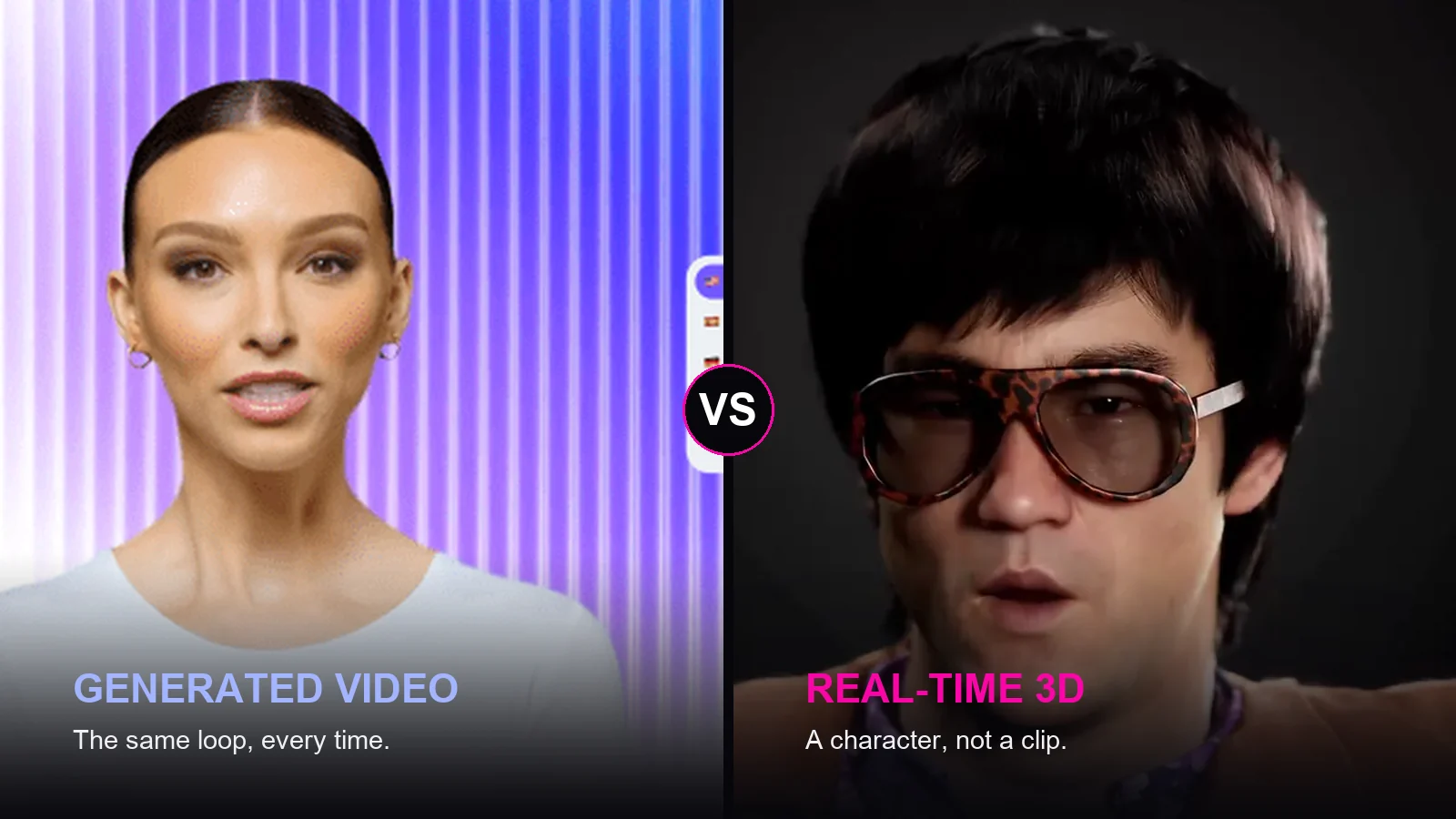
HeyGen is very good at what it does, and what it does is render video. Reviewers consistently report the motion looping once you pass a minute or two. If you need an audience to stay engaged for longer than that, you need a character in a space, not a face in a frame.
The short version
- HeyGen is genuinely good, and LiveAvatar is genuinely real time. This is not a takedown.
- It renders video. A cloud GPU produces avatar footage and streams it to you like a video call.
- Reviewers report the motion repeating past 60 to 90 seconds: blink patterns, hand gestures, a limited emotional range.
- That is a format ceiling, not a quality problem. A frame of video has nowhere to go.
- The alternative is a character with a body in a space you can move through, which behaves more like a game than a video call.
Most people arrive at this question the same way. They tried HeyGen, the first demo was genuinely impressive, and then something felt off in a way they could not name. Or they are scoping a project, the avatar has to hold attention for more than a minute, and they are not sure the format will carry it.
We build real-time 3D digital humans, so we are not a neutral party here. But an honest comparison is more useful than a hit piece, and HeyGen is a good product. So let us start with what it does well. If you would rather just talk through your use case, we are happy to do that.
What HeyGen Actually Does Well
HeyGen began as an AI video generator: type a script, pick an avatar, get a finished video. For scaled content production, localisation and personalised outbound, it is excellent. Nothing below changes that.
More relevant to this comparison is LiveAvatar, their real-time product. It is a proper engineering achievement and it works roughly like this: you speak, speech recognition transcribes, a language model produces the answer, text-to-speech generates the voice, a cloud GPU renders the matching avatar video, and the result streams back to you over WebRTC. You can bring your own language model, use custom avatars, and embed it.
So when people say HeyGen is "just pre-recorded video", that is out of date. It is live, it responds, and the latency is good.
The problem is not that HeyGen is fake. It is that HeyGen is video, and video has edges.
Main point
HeyGen is a video product, and an unusually good one. The question is not whether it works. It is whether video is the right container for what you are building.
The 90 Second Problem
Here is the pattern that shows up again and again in independent HeyGen reviews, and it is remarkably consistent about the timing.
Past roughly 60 to 90 seconds, reviewers report that the hand motion patterns begin to repeat. Blink patterns start cycling. The emotional range narrows to a small set of expressions that come round again. One review noted that frequent cuts hide this in edited content, while long static shots expose it. Longer scripts, the reviewer observed, reveal both the repetition and the limited palette.
That last detail is the important one. Editing hides the loop. Conversation does not.
A marketing video is 45 seconds and cut every few beats, so the repetition never surfaces. A museum visitor talking to a historical figure, a customer asking a concierge six questions, a fan at a stadium activation: those are long, uncut, single takes. Exactly the conditions that expose it.
Editing hides the loop. Conversation does not. Your audience is the long static shot.
And this is not a bug anyone can patch. It follows from the format. A model generating head-and-shoulders footage from audio has a finite library of motion to draw on, and a fixed frame to draw it in. Give it ninety seconds and you have seen the range. See what a character with its own rig and posture looks like instead.
Why a Frame Has a Ceiling
Strip away the model quality and the comparison gets simple.
With rendered video, you get a figure, cropped, against a backdrop, facing the camera. There is no space around the character, because none was ever built. There is no camera, because the framing is fixed. The character cannot walk anywhere, pick anything up, point at a real object or take you somewhere, because there is no anywhere to take you.
It is a window. The window is well made and the person in it is convincing. But the window never moves, and after a few minutes your attention notices that nothing behind the glass will ever change.
Main point
Video avatars compete on how convincing the face is. Once every vendor clears that bar, the only thing left to compete on is what else is in the frame. For video, the answer is nothing.
The Alternative Is Not a Better Face
At Digito we build the character in three dimensions and render it live. That single difference changes what becomes possible downstream.
- The character has a body, and the body is somewhere. A gallery, a stadium concourse, a showroom, a laboratory, or a place that exists only in the experience.
- The user controls the camera. They orbit, move closer, look behind things, step back. Nobody has ever orbited a video.
- The environment carries content. Objects can be examined, exhibits triggered, a product configured in front of you while the character explains what changed.
- Motion comes from a rig, not a library. A character with its own posture and gesture set behaves like itself, at minute one and at minute ten.
It behaves much closer to a video game than a video call. That is deliberate. Games solved the problem of holding attention for hours, and the answer was always agency plus environment.
This is the part that does not come across in a feature table, so here are two things we have actually built. Tell us what your audience should be able to walk into.
Bruce Lee: Presence Is Not the Same as Photorealism
Our Bruce Lee demo started as an R&D question. Photorealism is close to solved. Presence is not. Can a digital human carry timing, stillness, weight and a point of view, rather than simply looking correct?
What we learned is that presence lives in the things a video model has no way to produce: the pause before an answer, the shift of weight, the small movements that continue when nobody is speaking. A character rigged in 3D keeps being itself between lines, because it is a performance rather than a clip.
That is the difference between an avatar that delivers your script and a character someone remembers meeting. Browse the rest of the characters we have built.
Charles Darwin: The Space Is Half the Experience
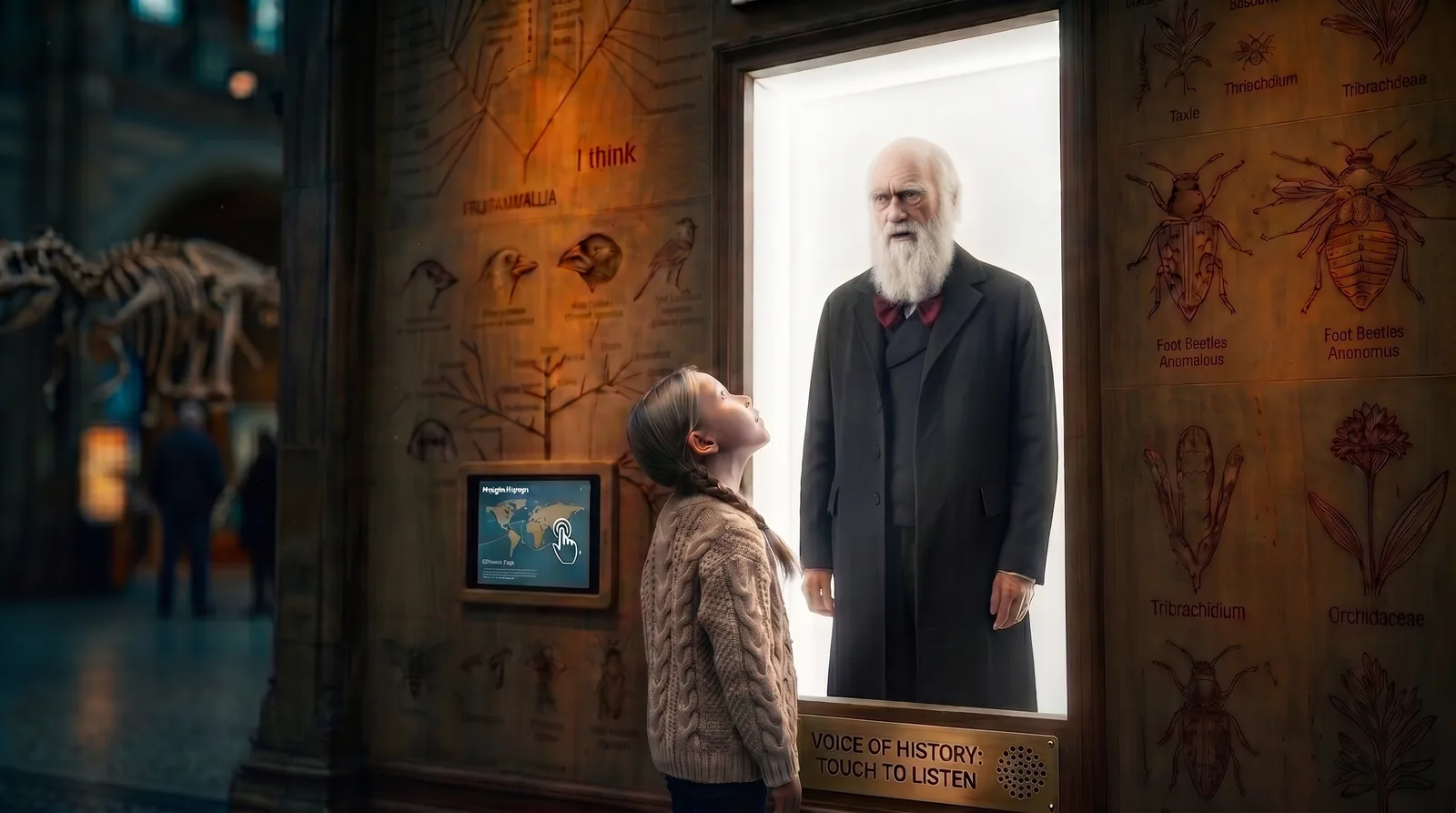
Darwin's Virtual Museum is the clearest demonstration of the gap, because you can go and use it right now.
Charles Darwin stands in a museum you can look around. Ask him anything: the Galapagos, natural selection, the voyage, the doubts he had before publishing. He answers in the first person, in real time, in your language, with knowledge grounded in the historical record.
A video avatar could deliver those same words. What it cannot do is put you in the room with the specimens, let you move closer to a display, or let a twelve year old wander off to look at something and come back with a better question. The knowledge is half of it. The presence and the place are the other half, and together they are what people repeat to someone else afterwards.
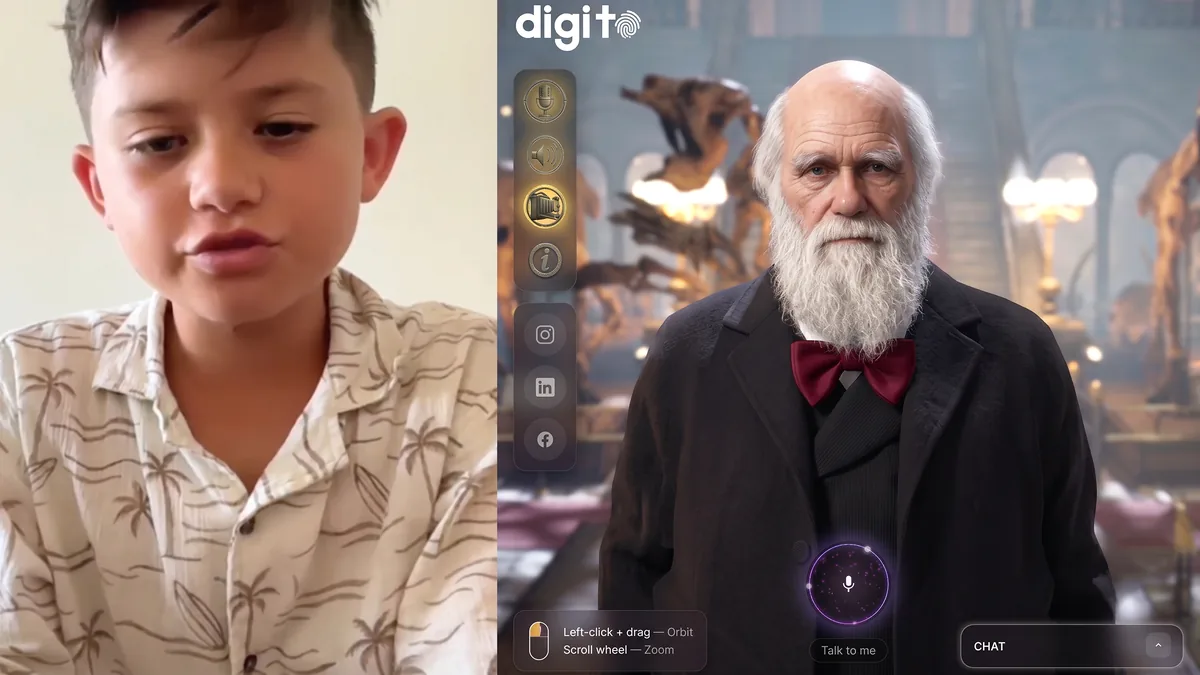
Live demo, no signup
Talk to Darwin yourself. Left-click and drag to orbit him, scroll to zoom, look around the room. Then try doing any of that to a video.
Main point
Spend sixty seconds with Darwin and sixty seconds with a video avatar. The difference is not resolution. It is that one of them is somewhere.
You Get to Decide What Reads as Real
There is a subtler problem with generated video, and it is the one people feel before they can explain it.
A video model trained on footage of real people can only produce one thing: something that looks like a real person, almost. Not stylised, not obviously synthetic, not photoreal enough to pass. It lands in the narrow band where your brain notices something is off and cannot say what. Hold eye contact with it for thirty seconds and the feeling arrives on schedule.
You cannot dial a video model away from the uncanny valley. It lives there, because that is what the training data pointed at.
With a 3D character, that position is a decision you make. You can go fully photoreal and commit to it, as we did with Bruce Lee, where the goal was a believable performance rather than a convincing still. Or you can move deliberately the other way, stylised and clearly a character, which is a legitimate and often smarter choice for a brand mascot, a children's exhibit or a game tie-in. Both are comfortable places to stand. The middle is the only uncomfortable one, and 3D lets you avoid it on purpose.
Main point
With video you get whatever realism the model produces. With 3D, where the character sits between stylised and photoreal is a design choice, and you can keep it well clear of the uncanny valley.
Look across our projects and you will see both ends of that scale, chosen deliberately each time. Tell us which end yours belongs at.
When HeyGen Is Genuinely the Right Choice
We would rather tell you this than have you find out after signing something.
If you need to produce a hundred product videos in twelve languages, HeyGen is the better tool and it is not close. If you want a talking head on a landing page, a personalised sales video, a training module or a social clip, the format fits the job. Short, edited, one directional content is exactly where video avatars are strongest, and where the repetition never has a chance to surface.
Do not buy a 3D experience to make marketing videos. You would be paying for a room nobody is going to walk around.
The picture changes when the conversation is long, unedited and two directional, and when the goal is dwell time, memory, or an experience someone tells a friend about. Museums, brand activations, stadiums, showrooms, visitor centres, flagship retail. Those are cases where the ninety second ceiling is not a detail, it is the whole problem. Tell us which of those you are working on.
The Honest Comparison
Two different products, aimed at two different jobs.
- HeyGen is a video platform with a real-time mode. It scales, it is quick to deploy, it is self serve, and it is priced per seat. Best for content at volume.
- A real-time 3D digital human is a built experience. It takes longer, it costs more, and it is made for one brand and one purpose. Best when attention is the product.
If you are comparing on price per video, HeyGen wins. If you are comparing on how long a stranger will stay and what they remember afterwards, that comparison is not close either, just in the other direction.
Main point
Ask one question and the answer falls out: does your audience watch, or do they visit? Watching is video. Visiting needs somewhere to go.
Where to Start
If you are evaluating a HeyGen alternative because something felt thin in testing, the useful next step is not another feature comparison. It is a minute with a 3D character, because the difference is immediate and does not survive being described in a table.
Spend that minute with Darwin, look through the characters and spaces we have built, and then tell us what you are trying to make. If HeyGen turns out to be the better fit for your use case, we will say so.
Digito builds conversational digital humans, real-time 3D avatars and immersive branded experiences: characters with a face, a body, a voice, and a place to stand. Start a conversation with us.