Industry
Let Kids Meet and Talk to Their Toys: The Next Era of Educational Play
Children have always talked to their toys. The only new thing is that the toy can answer back. The industry is getting this wrong by shipping open-ended chatbots where a designed character belongs, and by selling the technology instead of the friendship.
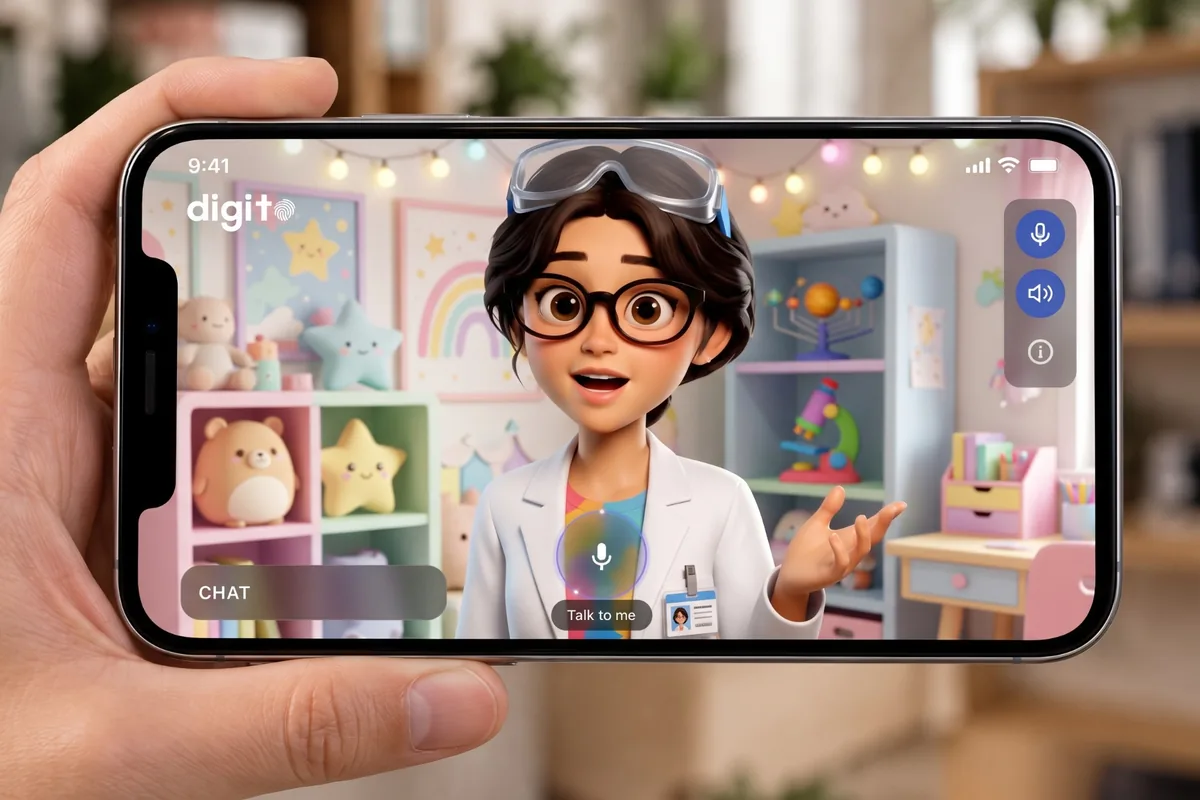
The short version
- Every major toy maker is now building talking characters. Mattel has a play-experience programme running, Hasbro launched a character studio called Sixth Wall, Spin Master bought an AI toy business outright.
- The first wave failed badly. Consumer testers found chatbot toys for toddlers with no meaningful child-safety limits at all.
- Hasbro drew the right line and said plainly it is not yet putting AI character personas in front of children.
- The failure is architectural. A general-purpose chatbot in a plush toy has no edges, no visible behaviour and no script a parent can check.
- A character is the opposite. Bounded knowledge, a fixed personality, a face you can see and a conversation a parent can watch happen.
- And stop calling it an AI toy. No child has ever wanted artificial intelligence. They want to meet someone.
Children have always talked to their toys. They have held conversations with a bear for an hour, given a plastic dinosaur a voice and a history, and asked a doll questions they would not ask an adult. None of that is new, and none of it needed inventing.
What is new is that the toy can answer. 2026 was the year the toy industry stopped asking whether that was possible and started arguing about how to do it. The answers so far have been wildly uneven, and the gap between the careful players and the reckless ones is now the most interesting thing in the category.
If you make toys, license characters, or run a children's brand, the practical question is no longer "should we do AI". It is "what exactly are we putting in front of a seven-year-old, and can we describe its limits in one sentence". That is a conversation worth having properly.
What the Toy Makers Actually Did
It is worth being clear about who the actors are here. The model vendors are suppliers, and interchangeable ones: a toy company can swap the engine behind a character the way it swaps a battery supplier. Every decision that matters, which character speaks, to whom, about what, and where the line sits, is being made inside toy companies. So that is where to look.
Mattel moved first and then moved slowly, which turns out to have been the right order. It announced a programme of age-appropriate AI play experiences in June 2025, alongside internal use in product development. What it did not announce was a toy. No product, no price, no launch date, and reporting since has noted the work leaning towards family and older-child products rather than anything aimed at a toddler, partly because the general-purpose assistants on the market are not built for under-13s in the first place.
Read that as a company discovering that its brand is the asset at risk. Mattel can rent a model from anyone. It cannot rent back the trust it would lose if a Barbie said something unforgivable.
Hasbro went further structurally. In June 2026 it launched Sixth Wall, a dedicated AI studio, with ElevenLabs as the first partner, putting characters including Optimus Prime, Megatron, Mr. Potato Head and Cobra Commander into licensed AI experiences. What Hasbro licenses is the interesting part: not just a voice, but personality, backstory and what Forbes described as the character's full creative DNA, governed by guardrail technology the studio calls CharacterOS.
And then Hasbro said the thing almost nobody else in the category has been willing to say out loud: it is not currently building AI character personas designed to interact with children, or to be embedded in toys. The offering is business to business, aimed at theme parks, venues, retailers and brand experiences.
The most sophisticated AI operation in the toy industry looked at putting its characters in front of children and said, not yet. That is not timidity. That is someone who understands the failure mode.
In March 2026 Hasbro also published a set of AI principles centred on safety, disclosure of where AI is used, and human sign-off on design and release decisions. Whatever you think of corporate principles documents, the direction is clear: the serious players are slowing down at exactly the point where the market is speeding up. See what a controlled, designed character actually looks like in practice.
Main point
The biggest toy companies are investing heavily in AI characters while deliberately keeping them away from young children. The gap between what is technically possible and what is responsibly shippable is the whole story.
What Went Wrong at the Other End of the Market
While Mattel and Hasbro moved carefully, a flood of cheaper AI toys reached shelves with no such restraint, and the results were genuinely alarming.
In November 2025, the US PIRG Education Fund included AI toys in its annual Trouble in Toyland report for the first time in the report's forty-year history. Its testers found chatbot toys marketed for children and toddlers that appeared to have no child-safety features in place, and that could be steered into discussing sexual topics or explaining where to find matches and knives.
The best-known case involved a plush teddy bear whose maker suspended sales and ran a safety audit after testers found it would engage in sexually explicit conversation. The model provider behind it cut the developer off for breaching its policies, which is worth noticing: the toy company had outsourced the one thing it could not afford to get wrong, and found out the same week as everybody else. The bear later returned in an improved form, but testers then flagged a different toy with similar problems, which tells you the issue was never one bad product.
A toy that can say anything will eventually say the worst possible thing. Not because it is malicious, but because "anything" includes that.
By January 2026, PIRG and Fairplay had written to toy companies asking for basic transparency: which models are used, how they were tested, what the guardrails are, and what happens to children's data. In March 2026, consumer groups and a US senator separately pressed the Federal Trade Commission, supporting its inquiry into AI companion products and pointing at potential violations of COPPA, the law governing children's data.
The regulatory picture is still open. The commercial picture is not. Trust in this category is now the scarce resource, and brands that already have it have the most to lose. If you are weighing that risk, we are a useful second opinion.
Main point
The first generation of AI toys did not fail on quality. It failed on boundaries, and it did so in public, in front of regulators.
A Chatbot Is Not a Character
Here is the distinction the whole category is missing, and it is not a marketing distinction. It is an architectural one.
A chatbot is general by design. Its value proposition is that it will answer anything. You then spend enormous effort bolting restrictions onto something whose core competence is having no edges. Every guardrail is a patch over a capability you deliberately bought.
A character is specific by design. It knows a defined body of material, it has a personality that does not drift, it has a job, and the things it will not discuss are not blocked so much as simply outside who it is. A marine biologist character does not refuse to discuss weapons. It genuinely has nothing to say about them, because its knowledge base is the ocean.
You cannot jailbreak a character into saying something it was never built to know. That is a different safety model entirely, and it is the one toys should be using.
This is also why the open-ended approach keeps producing the same headline. A general model wearing a bear costume is still a general model. The costume is not a constraint. Look at how a bounded character behaves instead.
It is worth noticing that Hasbro's own answer points the same way. Licensing a character's personality, backstory and creative DNA under guardrail technology is precisely an attempt to make the AI be someone rather than be anything. They arrived at the character model from the IP-protection direction. We arrived at it from the child-safety and education direction. It is the same conclusion.
What an Educational Companion Actually Looks Like
At Digito we build conversational avatars: real-time 3D characters with a face, a voice and a defined role. The clearest proof that this works on children comes from the hardest version of the problem, explaining something real to a child who has every reason to tune out.
Take a chronic skin condition. The leaflet is written for the parent, the clinician has eleven minutes, and the child goes home knowing they have something with a long name, that it itches, and not much else. A character built for that single job answers the question the child actually asked, at the child's reading level, as many times as they want to ask it, without anyone becoming impatient.
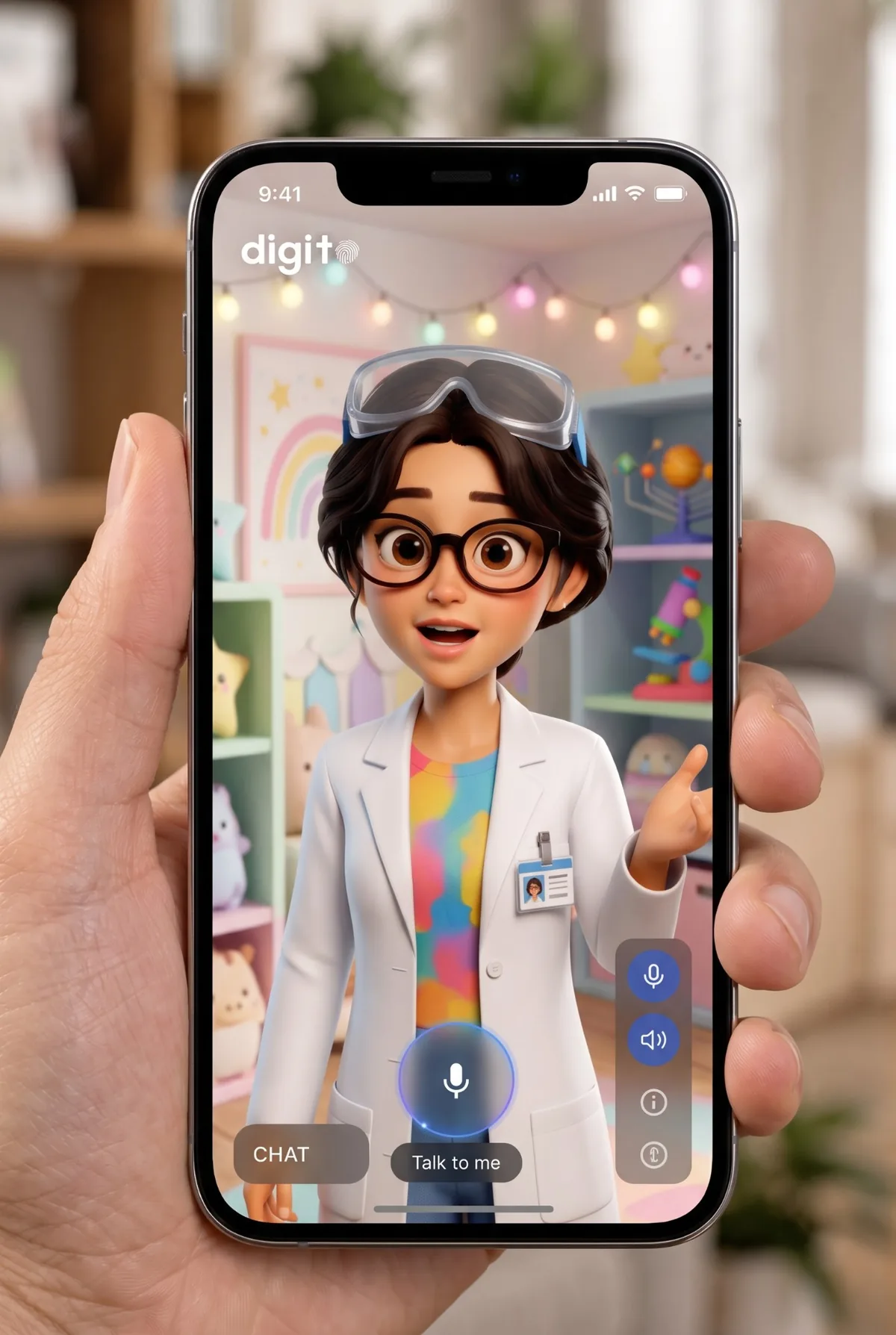
Change the subject and the same structure becomes play. A character who knows dinosaurs. One who knows how bridges stay up, or why the moon changes shape, and who is visibly delighted to be asked.
She has a name, a look a child recognises in ten seconds, and a personality that was written rather than generated. She is curious, patient and a little silly, every single time, because that was a design decision.
It runs in a browser on the parent's phone. No app, no install, no new device in the bedroom, and nothing shipped that cannot be corrected. We can build one around a character you already own.
Everything that makes that safe is a design decision made before a single conversation happens. The character knows one subject. Its tone was written deliberately. Its knowledge base is a document somebody approved. When a child asks something outside the brief, it says so and points at a grown-up, because that is in character for it.
The limits work the same way whatever the subject. A character who knows one book series inside out will discuss it for an hour and never leave it, because leaving it is not something it can do. That is the same thing we build for museums, applied to a younger audience.
Main point
Safety in a children's character is not a filter applied at the end. It is the scope you chose at the beginning, and scope is a creative decision before it is a technical one.
Why a Screen Is a Feature, Not a Compromise
The instinct in the toy industry is to hide the technology inside the plush. It feels like magic, and magic is the business. But for AI specifically, the hiding is the problem.
A parent cannot see what a bear is saying. There is no transcript, no screen, no way to drop in on the conversation without interrupting it. The microphone is always in the room, and the conversation happens in a bedroom at the exact moment the parent is somewhere else.
A visible character inverts all of that. The parent can watch it, join in, scroll back, hand the phone over and take it back. Play with a screen is easier to supervise than play with a hidden speaker, which is the opposite of what the category assumes.
The teddy bear is the worst possible enclosure for a conversational AI. It removes every signal a parent would use to judge whether this is going well.
It also keeps the hardware question out of the way. A conversational avatar that runs in a browser needs no new device, no firmware updates, no connected microphone in a child's room, and it can be corrected centrally the moment something needs changing. A toy that shipped last Christmas cannot be fixed. Ask us how the deployment side actually works.
Nobody Wants to Buy an "AI Toy"
The category made a marketing error before it made a safety one. It named itself after its own technology.
"AI toy" is a terrible thing to put on a box. A parent reads it and thinks about data collection, screen time, and the news story about the teddy bear. A child reads it and feels nothing at all, because no six-year-old has ever wanted artificial intelligence. They want to meet someone. Those are the only two people in the purchase, and the label works on neither of them.
Children have always talked to their toys. The only new thing is that the toy can answer. Sell that, not the machinery behind it.
Compare the two pitches. "AI-powered interactive learning companion with natural language processing" is a spec sheet. "Talk to Rex. Ask him anything about dinosaurs" is a reason to take it to the till. The second one is also more honest, because it describes exactly what the thing does and quietly states its limits in the same breath.
This is not spin. The naming problem and the safety problem have the same root. A product sold as general intelligence has to be general, and a product sold as Rex only has to be Rex. The moment you commit to the character in your marketing, you have committed to the scope in your engineering. That decision is worth making before the build starts, not after.
Main point
Lead with the character, never the technology. Nobody is buying artificial intelligence for a seven-year-old. They are buying a friend who knows about dinosaurs.
If You Already Own the Characters, You Are Holding the Hard Part
This is the part the toy industry consistently undervalues. The scarce asset in conversational AI is not the model. Models are rented by the month. The scarce asset is a character a child already loves and already trusts, with decades of established personality behind it.
Mattel, Hasbro, Spin Master, LEGO and every publisher with a beloved character have exactly that, and they are mostly sitting on it while unknown brands ship unsafe products into the same category and degrade trust for everyone.
The opportunity is not "put a chatbot in the doll". It is to take a character people already know, give it a defined educational role, write its knowledge and its limits deliberately, and let children have a real conversation with it in a place a parent can see. That is precisely the kind of project we take on.
You do not need a new character. You need the one you already own to be able to answer a question.
Analysts put the broader smart toy market somewhere around fifteen billion dollars in 2026, growing in the mid-teens annually, though definitions vary so widely between research houses that the specific number matters less than the direction. Educational toys are consistently reported as the largest slice of it. See the work before you decide whether we are the right studio.
What We Would Build, If You Asked
A single character, not a platform. One subject it knows properly. A personality written rather than generated. A face and a voice that a child recognises after ten seconds. A browser link, so it works on the device the family already has. A knowledge base you approve and can change on a Tuesday afternoon.
And an honest answer, before any of that, about whether your idea needs a conversational avatar at all. Plenty do not, and we would rather say so than take the project. Tell us what you want a child to understand, and who should explain it.
Digito builds conversational avatars, digital humans and immersive 3D experiences: characters with a face, a voice, a defined role and a place to stand, for brands, museums, education and live events. If you are a toy company, a publisher or a children's brand weighing up how to do this without ending up in next year's consumer safety report, start a conversation with us.