Industry
Synthesia Alternative: Why a Talking Avatar Loses the Room at Minute 30
Synthesia is the best tool in the world for turning a script into video at enterprise scale. It is not built to hold a room for half an hour, and reviewers say so plainly. If your problem is attention rather than production volume, you are solving a different problem.
The short version
- Synthesia is excellent and half the Fortune 100 use it. Version 3.0 added full-body avatars and real-time Video Agents.
- It is a production tool. Its job is turning scripts into video, in many languages, at volume.
- Reviewers report the format going monotonous over a 30 minute stretch. The constraint is attention, not avatar quality.
- Long-form learning is where that hurts most, because compliance and onboarding are exactly the 30 minute case.
- The alternative is not a better presenter. It is a place the learner moves through instead of watches.
Searches for a Synthesia alternative usually come from one of two places. Either the pricing stopped making sense at your volume, or you sat through your own finished module and realised you had stopped paying attention to it somewhere around minute twelve.
The first is a procurement question and other video tools will answer it. The second is not a tooling problem at all, and swapping one avatar video platform for another will not fix it. If that second one is your situation, it is worth a conversation.
Synthesia Is Genuinely Very Good
It is worth being specific about this, because vague praise before a critique reads as insincere.
Synthesia 3.0 was a serious overhaul. Express-2 avatars are full body, with hand and body gestures that respond to the script rather than looping generically, so a presenter can point, gesture and emphasise. Video Agents added genuine two-way conversation: an avatar that listens, responds, and draws on a connected knowledge base such as SharePoint, Google Drive or a CRM. That is a real product, aimed squarely at interactive training, screening and support.
Around half of the Fortune 100 use it, and for good reason. If your job is to produce onboarding, compliance and product training in twenty languages, keep it current as policies change, and do it without a studio or a crew, nothing we build competes with that. It would be dishonest to pretend otherwise.
Synthesia solves how to make a thousand videos. That is a real problem, and they solve it better than anyone.
Main point
Synthesia is a production tool, and it is the best one. The question is whether production volume is actually your bottleneck, or whether attention is.
The Minute 30 Problem
Here is the criticism that keeps appearing in independent reviews, and it is not really about Synthesia.
Reviewers note that Express-2 avatars, for all the improvement, can still look stiff in motion, particularly during hand gestures and longer monologues, and that they do not fully pass for a real person. More pointedly, one review observed that a single talking avatar still gets monotonous over a thirty minute stretch, and identified the constraint precisely: viewer attention and the template format.
That is the whole issue in one sentence. It is not that the avatar is bad. It is that one presenter, in one frame, talking for half an hour, is a format with a known attention curve, and it does not matter whether the presenter is synthetic or human.
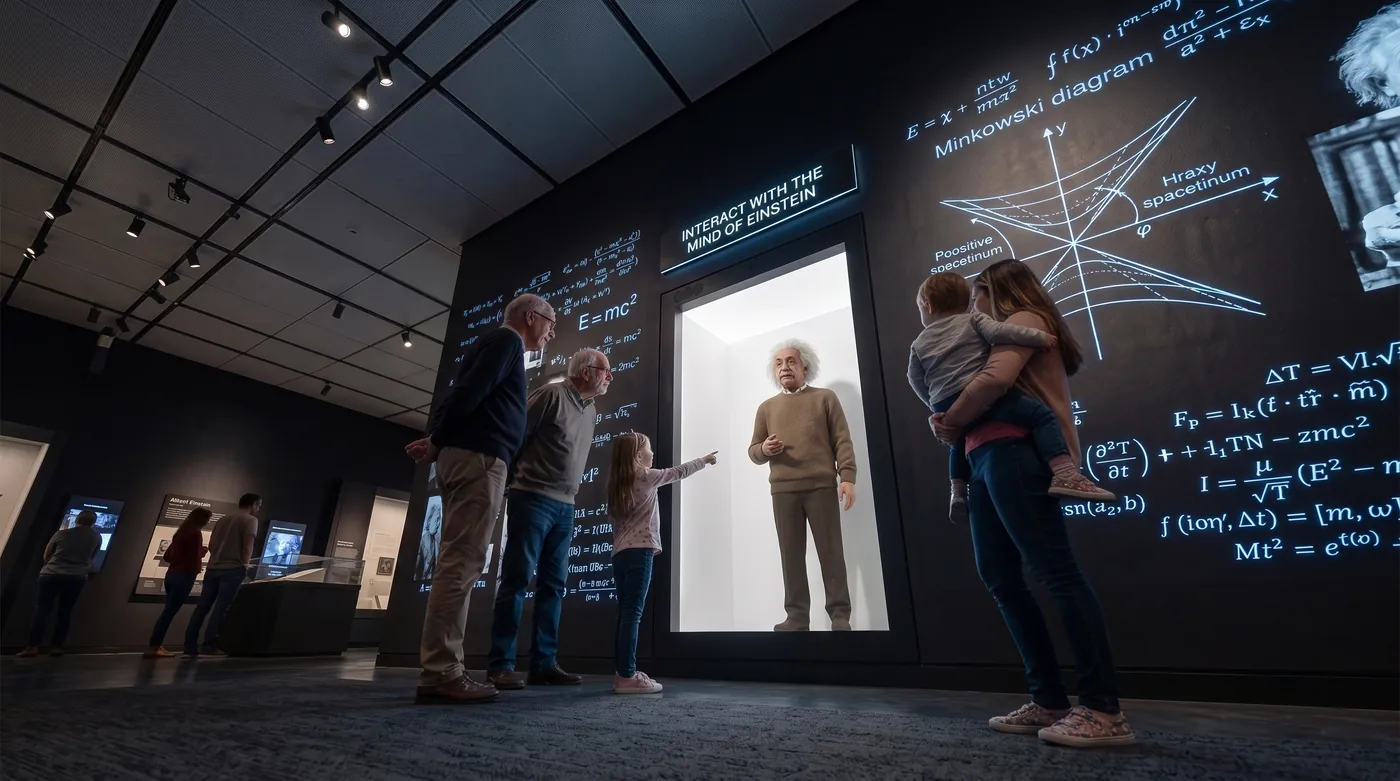
See what a character in a space looks like instead.
The constraint was never the avatar. It was the format. A person filmed against the same backdrop for thirty minutes loses the room too.
Reviews also point out that avatar-led video struggles with emotional delivery and authenticity in ways that affect conversion, and that quality varies across a library of hundreds of stock avatars. Both are fair. But they are refinements of the same underlying point: you are asking a viewer to watch, passively, for a long time.
Why This Bites Hardest in Training
Compliance modules, onboarding programmes and procedural training are precisely the thirty minute case. They are also the content where it matters most whether anything was retained, because the entire reason the module exists is that someone has to actually know this.
Watching is a low-engagement state. The learner is not making decisions, not being asked anything, not doing anything with their hands or their attention. They can be fully compliant with the training requirement and remember very little of it, and completion rates will not tell you that happened.
Main point
Completion is not comprehension. A module can be finished by everyone and remembered by almost nobody, and a video platform has no way to tell you which happened.
This is also why Video Agents are a smart move on Synthesia's part. Letting the learner ask questions turns a monologue into a conversation, which is a real improvement. It just does not change where the conversation happens, which is still a rectangle on a slide. We put the conversation somewhere.
What Changes When Training Has a Place
At Digito we build real-time 3D digital humans that exist in rendered environments. For learning content specifically, that changes three things.
- The learner does something. They move, look around, approach, choose where to go next. Attention that is being spent rather than merely held behaves completely differently.
- The environment teaches. If the subject is a machine, a ward, a shop floor or a gallery, the learner can be in a version of it rather than watching a slide about it. Procedure learned in a space is recalled in that space.
- The character stays a character. An instructor with its own posture, timing and point of view is still itself at minute thirty, because it is being performed rather than played back.
Watching is something you do to a video. Visiting is something you do to a place. Only one of them asks anything of the learner.
None of this is free. A built environment costs more than a generated video and takes longer. That trade is worth making when retention actually matters, and not worth making when you need this quarter's policy update out to twelve thousand people by Friday. We will tell you honestly which situation you are in.
Charles Darwin, and What an Explorable Lesson Looks Like
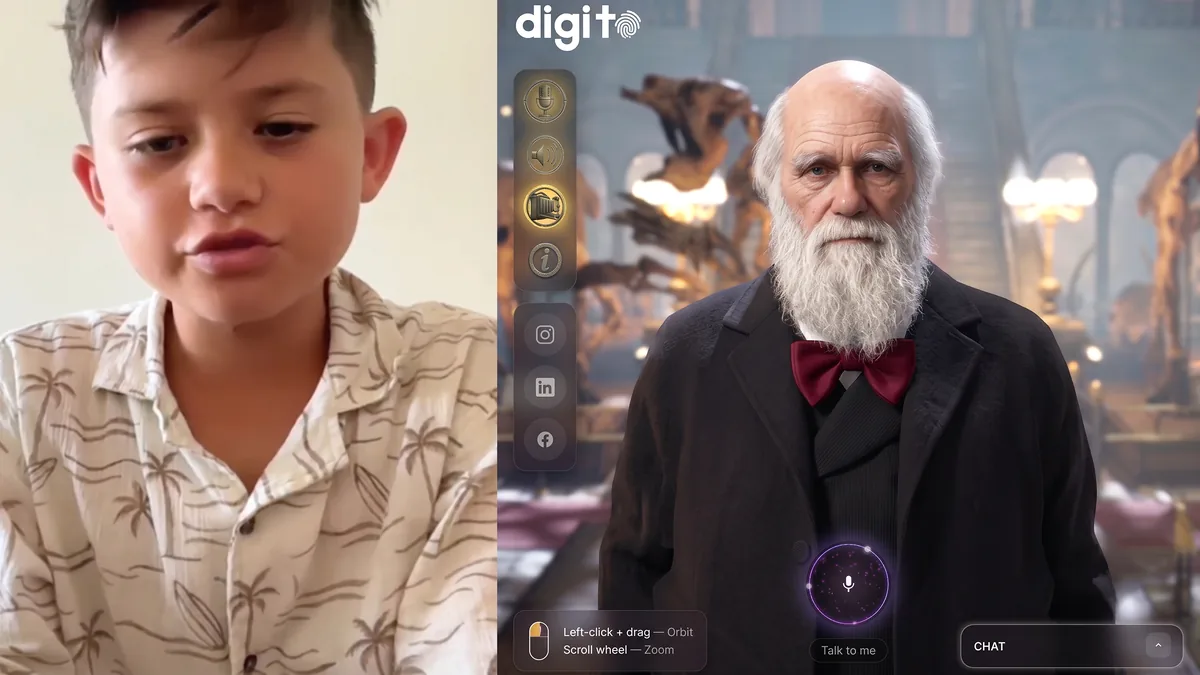
Darwin's Virtual Museum is our clearest education example, and you can go and use it rather than take our word for it.
Charles Darwin stands in a museum space you can look around. A visitor asks him anything: the Galapagos, natural selection, the voyage, the doubts he had before publishing. He answers in the first person, in real time, in their language, grounded in the historical record.
Put that beside a thirty minute video about Darwin. The video may well contain more facts. But the child who wandered off to look at a specimen, came back with a better question, and got an answer from the man himself is the one who will still be talking about it at dinner. See the other characters and spaces we have built.
Live demo, no signup
Ask Darwin something awkward and see how long you stay. That is the number that matters in training.
When Synthesia Is the Right Answer
Most of the time, honestly. We would rather say so than win a project we are wrong for.
- Volume. Hundreds of modules, refreshed as policy changes. No bespoke build competes on cost per video.
- Languages. Same script, twenty locales, consistent presenter. This is Synthesia at its strongest.
- Speed. A script this morning, a finished module this afternoon.
- Internal communications. Executive updates and policy announcements do not need an environment. They need to be clear and out the door.
Use a built experience when the content is the flagship rather than the backlog: an induction that sets the tone for a whole career, a safety procedure where recall is the difference between routine and incident, a visitor centre, a museum, a brand space, a product people are deciding whether to buy.
Main point
Use a video platform for the backlog. Use a built experience for the flagship. Most organisations need both, and confuse which is which.
The Question Worth Asking
If you are evaluating a Synthesia alternative, most of the comparisons you will read are about price per minute, avatar counts and language support. Those matter if you are buying a production tool.
If you are actually trying to fix engagement, the useful question is different and slightly uncomfortable: does anyone remember this a week later? If the honest answer is no, a different video platform will produce the same result more cheaply, and the problem will still be there.
We wrote a related piece on why generated video avatars hit a ceiling in live conversation, and a longer one on why AI avatars bore audiences without anyone noticing. Both come back to the same place: the format decides the ceiling.
Spend a minute with Darwin, look at what we have built, then tell us what you are trying to teach and to whom. If Synthesia is the better fit, we will say so.
Digito builds conversational digital humans, real-time 3D avatars and immersive learning environments: characters with a face, a body, a voice, and a place to stand. Start a conversation with us.